


 0
0
 Home
Home News
News

 Directory
 E-newsletter
 Magazine
 Events
 Data
Data AgReport
 Subscribe
-
Common NameCaptan
-
中文通用名克菌丹
-
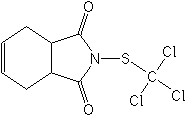
IUPACN-(trichloromethylthio)cyclohex-4-ene-1,2-dicarboximide
-
CAS3a,4,7,7a-tetrahydro-2-[(trichloromethyl)thio]-1H-isoindole-1,3(2H)-dione
-
CAS No.133-06-2
-
Molecular FormulaC9H8Cl3NO2S
-
Molecular Structure
-
Category
-
ActivityCaptan provides consistent control of the most damaging diseases that attack apple, almond, stone fruit and berry. Along with superior efficacy against primary and secondary scab, captan delivers broad-spectrum control of many other diseases such as black rot (frogeye), sooty blotch, fly speck, black rot, Botryosphaeria rot, bull's eye rot, Botrytis rot and bitter rot.
-
PremixPyraclostrobin+Captan
Imidacloprid+captan+carboxin
Difenoconazole+Captan
Captan+Trifloxystrobin
Captan+tebuconazole
Captan+Carbendazim
Captan+Bromothalonil
Dust, flowable, wettable powder. Premix Parters: lindane;
-
Physical PropertiesMolecular weight:300.6; Physical form: Colourless crystals; (tech. is a colourless to beige amorphous solid, with a pungent odour). Density:1.74 (26 °C); Composition:Tech. is 90-95% pure. Melting point:178 °C (tech., 175-178 °C); Vapour pressure:<1.3 mPa(25 °C); Henry constant:<1.18×10⁻¹ Pa m3 mol-1 (calc.); Partition coefficient(n-octanol and water):logP = 2.8 (25 °C); Solubility:In water 3.3 mg/l (25 °C). In xylene 20, chloroform 70, acetone 21, cyclohexanone 23, dioxane 47, benzene 21, toluene 6.9, isopropanol 1.7, ethanol 2.9, diethyl ether 2.5 (all in g/kg, 26 °C). Insoluble in petroleum oils.; Stability:Hydrolysed slowly at neutral pH, rapidly in alkali. Thermal DT50 >4 y (80 °C), 14.2 d (120 °C). Very low solubility in organic solvents. Insoluble in petroleum oils. Solubility at 25°C: in xylene 20 g/kg; chloroform 70 g/kg; acetone 20 g/kg; cyclohexanone 20 g/kg; 2-propanol 1 g/kg.
-
ToxicologyOral:Acute oral LD50 for rats 9000 mg/kg. Percutaneous:Acute percutaneous LD50 for rabbits >4500 mg/kg. Corrosive to eyes; mild skin irritant (rabbits). Inhalation:LC50 for male rats >0.72, female rats 0.87 mg/l (tech.). Dust may cause respiratory irritation. Phytotoxicity:Non-phytotoxic if used as directed, but some varieties of apple (e.g. Red Delicious, Winesap) and pear (e.g. D'Anjou, Bosc) may be injured, as also may lettuce seeds and, at higher dosage
-
Environmental ProfileEcotoxicology: Bees:ED50 (oral) 91; (contact) 788
mg/bee.Birds:Acute oral LD50 for mallard ducks and pheasants >5000, bobwhite quail 2000-4000 mg/kg. Not toxic to starlings or red-winged blackbirds at 100 mg/kg.Daphnia: LC50 (48 h) 7-10 ppm.Fish:LC50(96 h) for bluegill sunfish 0.047-0.111 ppm,rainbow 0.066-0.080 ppm (96 h), trout harlequin fish 0.3 mg/l, brook trout 0.034 mg/l.Other aquatic spp.:Moderately toxic to aquatic invertebrates. Environmental fate: Animals:In mammals, the three chlorine atoms are cleaved under the influence of cellular sulfhydryl compounds. Trithiocarbamate, thiophosgene, and tetrahydrophthalimide are formed (R. G. Owens, Ann. New York Acad. Sci., 1969, 160, 114-13Soil:Soil Kd 3-8 (pH 4.5-7.2, o.m. 2.2-6.7%); DT50 c. 1 d (25 °C, pH 7.2, o.m. 1.2%). WATER SOLUBILITY: <5 mg/l at room temperature. -
Transport InformationSignal Word:DANGER; Hazard Class:Ib (Highly hazardous)
Porduct NewsMore
Australia approves emergency use permit for chickpea fungicide captan
Related CompaniesMore
Hebei Guanlong Agrochemical Co.,Ltd
Country: China
Thiram Ziram Captan Dimethomorph Flusilazole Acetamiprid Iprodione Difenoconazole Prochloraz Azoxystrobin
Shenzhen Baocheng Chemical Industry CO.,LTD.
Country: China
Glyphosate Emamectin benzoate Lambda-cyhalothrin Pyraclostrobin Bromacil Glufosinate-ammonium Tembotrione Prothioconazole Topramezone Chlorantraniliprole
Hangzhou Ruijiang Crop Science Co., Ltd
Country: China
Glyphosate 2,4-D Paraquat Nicosulfuron Imidacloprid Carbendazim Dicamba+2,4-D Pyraclostrobin Spirodiclofen Seaweed Extract Amino Acid Agriculural Organosilicone Adjuvant
Country: China
Glufosinate-ammonium 2,4-D MCPA Dicamba Propanil Clethodim Glyphosate Captan Flumioxazin Sulfentrazone
Yingde Greatchem Chemicals Co., Ltd.
Country: China
Folpet Desmedipham Dazomet Captan Triticonazole Ipconazole Metconazole Boscalid Thifluzamide Ethofumesate